Best Campgrounds for Large Rigs: Complete Guide for Class A Owners
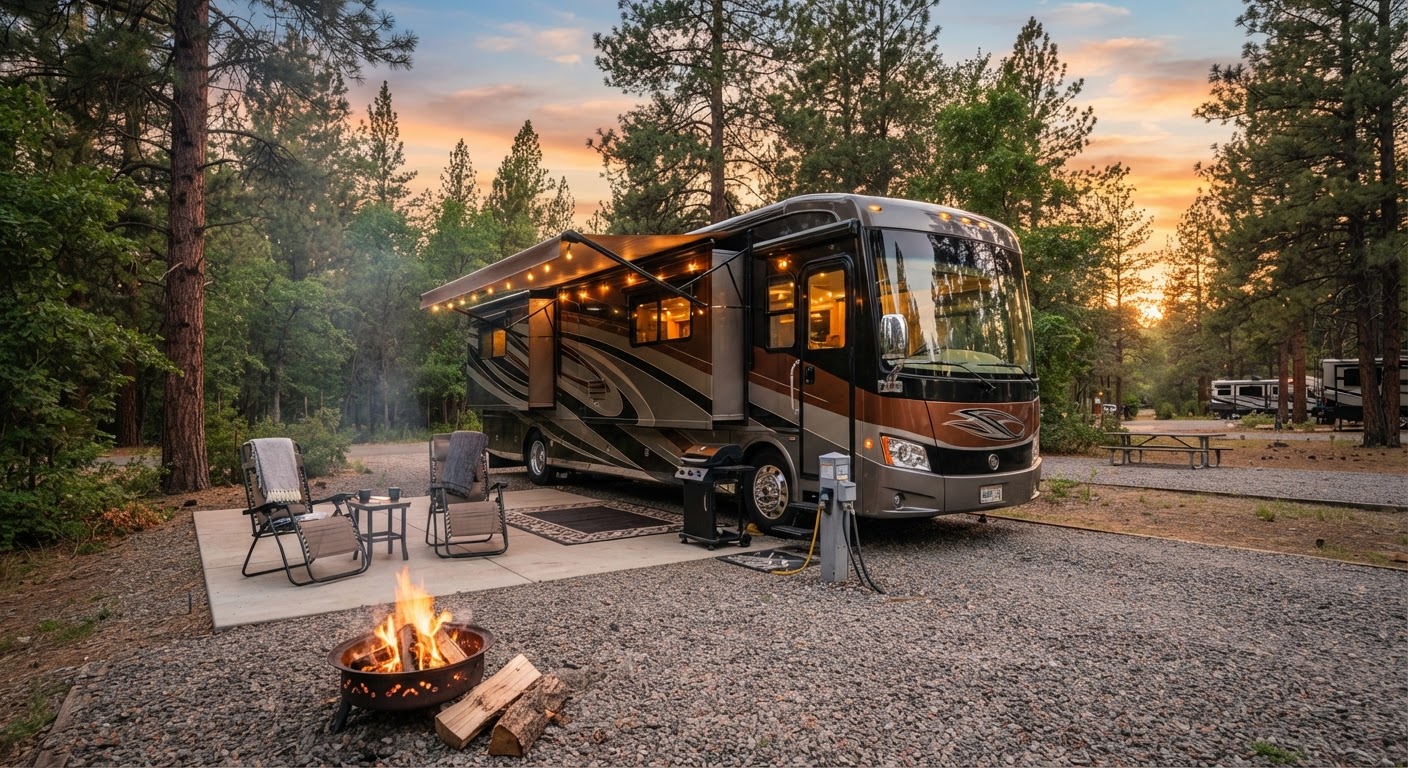
Let's get real: owning a Class A motorhome is incredible. The space, the comfort, the ability to bring your entire life on the road—it's the dream.
Until you try to book a campground.
"Maximum RV length: 35 feet!"
You're 38 feet.
"Back-in sites only!"
You'd rather not jackknife your $200K rig in front of an audience.
"Pull-through available!"
Narrator: It was not actually available.
Finding campgrounds that truly accommodate large rigs is part skill, part research, and part knowing which "RV-friendly" claims to trust.
If you're rolling in a 35+ foot Class A (or even a smaller rig with a tow vehicle), this guide is for you.
What Makes a Campground "Big Rig Friendly"?
Not all RV campgrounds are created equal. Here's what actually matters for large motorhomes:
1. Honest Length Limits
The #1 frustration: campgrounds that say "up to 40 feet!" but fail to mention:
- That's 40 feet total including your tow vehicle
- The turn to get into the site requires a 50-point turn
- The site itself is technically 40 feet, but with a picnic table and fire ring, your slides don't fit
What to look for:
- Sites listed at least 5 feet longer than your rig (buffer room)
- Reviews from other Class A owners confirming it fits comfortably
- Site maps or photos showing actual dimensions
2. Pull-Through Sites (The Gold Standard)
If you've ever tried to back a 40-foot Class A into a tight spot with trees on both sides while your partner gives increasingly frantic hand signals... you understand the appeal of pull-throughs.
Why pull-throughs matter:
- No backing required (or minimal)
- Easier setup and tear-down
- Less stress, especially if you're new to RVing
- Faster check-in when you arrive tired after a long drive
Pro tip: Even if the campground has pull-throughs, confirm when you book that one will be available for your dates. Don't assume.
3. Site Width and Slide-Out Space
Your Class A probably has at least one slide-out. Maybe three.
A site that's technically long enough but only 15 feet wide means:
- Your slides extend into the neighbor's space (awkward)
- You can't fully open slides without hitting trees or picnic tables
- Good luck fitting your awning
What to look for:
- Site widths of at least 20-25 feet for full slide extension
- Clearance from trees, utility pedestals, and fixed structures
- Level sites (because leveling a 20,000-lb rig on unlevel ground is... not fun)
4. Interior Road Width and Turn Radius
You can have the perfect site, but if you can't actually get there, it's useless.
Red flags:
- Narrow roads (less than 20 feet wide)
- Tight 90-degree turns
- Low-hanging branches that'll scrape your roof or AC units
- Steep grades on interior roads (especially if it rained recently)
What to check:
- Satellite view on Google Maps (zoom in on campground roads)
- Reviews mentioning "tight turns" or "difficult navigation"
- Call ahead and ask about road width and turning radius
5. Full Hookups (Especially for Longer Stays)
Class A motorhomes have bigger holding tanks than travel trailers, but if you're staying more than a couple nights, full hookups make life infinitely easier.
What you want:
- 50-amp electric (30-amp works with an adapter, but you'll limit AC usage)
- Water hookup (so you're not running to the spigot with a hose)
- Sewer connection at the site (beats dragging a stinky hose to the dump station)
Bonus points:
- Cable TV or strong WiFi (cellular boosters help, but hookups are better)
- Concrete pads (better leveling and drainage than gravel or dirt)
6. Accessible Amenities
Your rig is big. You need amenities designed with that in mind:
- Dump stations with plenty of room to maneuver (not tucked behind a building)
- Propane fill stations accessible without unhitching
- Laundry, showers, and restrooms within reasonable walking distance
- Big-rig parking at the camp store or office (not "park in the lot and walk 1/4 mile")
Red Flags: When to Keep Scrolling
Some campgrounds say they're big-rig-friendly. Here's how to spot the ones that aren't:
🚩 "RV sites available" (but no specific length mentioned)
🚩 "Some pull-throughs" (probably 2 sites out of 50, both already booked)
🚩 "Rustic RV camping" (translation: minimal infrastructure, tight spaces, questionable roads)
🚩 Reviews mentioning "cozy," "quaint," or "tucked in the woods" (great for tent campers, nightmare for Class As)
🚩 No site map or photos on the website (either they're hiding something or haven't updated since 2003)
🚩 "Call for availability" only (not necessarily bad, but often means limited big-rig sites)
Types of Campgrounds and What to Expect
National and State Parks
Pros:
- Stunning locations
- Lower cost
- Well-maintained (usually)
Cons:
- Often have some big-rig sites, but not many
- Reservations fill up 6+ months in advance
- Roads can be tight (these parks were built before 40-foot RVs were common)
- Limited or no hookups
Big-rig-friendly examples:
- Gulf State Park (Alabama) – pull-throughs up to 65 feet
- Cherry Creek State Park (Colorado) – sites up to 55 feet
- South Llano River State Park (Texas) – big-rig-friendly with full hookups
Verdict: Do your homework. Some are excellent for Class As; some are impossible.
Private RV Resorts
Pros:
- Designed specifically for large RVs
- Full hookups standard
- Wide roads, pull-throughs, level concrete pads
- Amenities like pools, clubhouses, and activities
Cons:
- More expensive ($50-100+/night)
- Can feel crowded or "RV parking lot" vibes
- Location may prioritize convenience over scenery
Big-rig-friendly examples:
- Motorcoach Country Club (Indio, CA) – luxury for high-end rigs
- Thousand Trails locations (nationwide) – membership-based, many big-rig sites
- KOA Journey and Resort locations – consistently accommodate large RVs
Verdict: Your safest bet for hassle-free big-rig camping, especially if you're new or traveling peak season.
County and Regional Parks
Pros:
- Middle-ground pricing
- Often spacious and well-maintained
- Less crowded than private resorts
Cons:
- Hit-or-miss for large RVs (some are great, some aren't)
- Fewer amenities than private resorts
Verdict: Research each one individually. Hidden gems exist, but so do tight squeezes.
Boondocking / Dry Camping
Pros:
- Free or very cheap
- Incredible locations (BLM land, national forests, etc.)
- Space and solitude
Cons:
- No hookups (you need robust solar, fresh water capacity, and holding tanks)
- Road conditions can be sketchy for large rigs
- Leveling on unimproved sites is challenging
Verdict: Doable for Class As with the right setup, but do serious research on road conditions and accessibility first.
How to Actually Find Big-Rig-Friendly Campgrounds
Step 1: Use RV-Specific Tools
General campground sites (ReserveAmerica, Recreation.gov) don't filter well for big rigs.
Try:
- Campendium (real reviews from RVers, including rig size)
- RV Parky (user-submitted info with filters for length)
- AllStays (massive database, shows RV-specific details)
- Good Sam (trusted network with member reviews)
Filter by:
- Minimum site length (your rig + 5-10 feet)
- Pull-through availability
- Full hookups
- User ratings from Class A owners
Step 2: Read Reviews from Big-Rig Owners
Don't just read any reviews—find reviewers with similar-sized rigs.
Look for mentions of:
- "Fit my 38-foot Class A with room to spare"
- "Pull-through was easy to navigate"
- "Tight turns, wouldn't recommend for rigs over 30 feet"
If nobody with a big rig has reviewed it recently, proceed with caution.
Step 3: Call Ahead and Ask Specific Questions
Seriously. Five minutes on the phone can save you hours of frustration.
Questions to ask:
- "I have a [length] Class A motorhome. Which specific sites can accommodate me?"
- "Are your pull-throughs actually pull-through, or do I need to back in?"
- "What's the width of interior roads and turning radius?"
- "Are there any low branches or tight corners I should know about?"
- "Do you have 50-amp service?"
If they can't answer confidently, consider that a yellow flag.
Step 4: Use Satellite View
Google Maps satellite view is your friend.
Zoom in on the campground and look for:
- Width of interior roads
- Site spacing
- Tree coverage (beautiful, but potential clearance issues)
- Entry/exit points
This won't tell you everything, but it'll catch obvious red flags.
Let AI Do the Heavy Lifting
Here's the reality: finding big-rig-friendly campgrounds for every night of a multi-stop trip is time-consuming.
You're not just looking for "a campground." You're looking for:
- One that fits your 38-foot Class A
- With pull-through sites available on your exact dates
- Along your route without massive detours
- Ideally near the activities you planned
- At a price that doesn't blow your budget
Multiply that by 7 nights. Then factor in backup options.
This is exactly why RV Roost exists.
Our AI doesn't just find campgrounds—it finds the right campgrounds for your specific rig and builds them into a complete trip itinerary.
You tell us:
- Your RV specs (Class A, 38 feet, slides, etc.)
- Where you want to go
- Your preferences (full hookups, pull-throughs, budget)
The AI builds a trip with campgrounds that:
✅ Fit your rig (confirmed length and width)
✅ Have availability on your dates
✅ Match your preferences (hookups, amenities, reviews)
✅ Make routing sense (no backtracking or 3-hour detours)
No more juggling five websites, reading 47 reviews, and still wondering if you'll actually fit.
Final Thoughts: Your Rig Deserves Better
Driving a Class A motorhome is a lifestyle choice. You didn't buy a 40-foot land yacht to squeeze into undersized campsites and stress about clearance.
You deserve campgrounds designed for rigs like yours. Sites where you can pull in, set up, and actually relax.
The good news? They exist. You just need to know where to look—and have the tools to find them without spending half your trip planning.
Ready to find your next big-rig-friendly campground in seconds? Try RV Roost free for 7 days and let AI match you with campsites that actually fit your Class A. No guesswork, no tight squeezes—just great camping.